In 2017, historian Judith Giesberg and her team of graduate student researchers launched a website called Last Seen: Finding Family After Slavery. It now contains over 4,500 ads placed in newspapers by formerly enslaved people who hoped to find family members separated by slavery. The earliest ads date from the 1830s and stretch into the 1920s.
Giesberg says that when she’s given public lectures about this online archive of ads, the audience always asks “the” question: “‘Did they find each other?'” Giesberg writes:
I always answer the question the same way. And no one is ever satisfied with it. “I don’t know.”
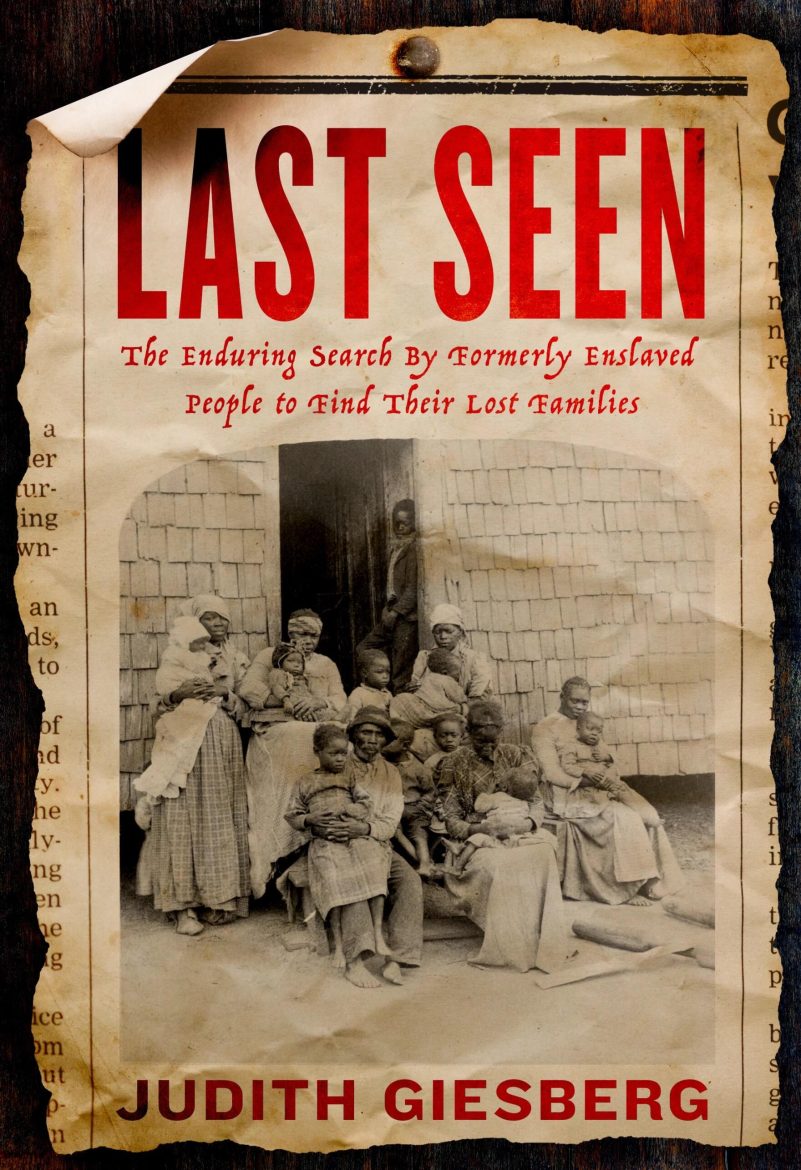
Giesberg’s new book, called Last Seen: The Enduring Search by Formerly Enslaved People to Find Their Lost Families, is her more detailed response to the question. In each of the 10 chapters here, she closely reads ads placed in search of lost children, mothers, wives, siblings and even comrades who served in the United States Colored Troops during the Civil War.
Giesberg isn’t trying to generate reunion stories. Although there are a couple of those in this book, Giesberg tells us the cruel reality was that: “The success rate of these advertisements may have been as low as 2%.”
Instead of happy endings, these ads offer readers something else: they serve as portals into “the lived experience of slavery.” For instance, countering the “Lost Cause” myth that enslaved people were settled on Southern plantations and Texas cotton fields, the ads, which often list multiple names of white “owners” as a finding aid, testify to how Black people were sold and resold.
The ads that hit hardest are the ones that illuminate what Giesberg refers to as: “America’s traffic in children.” She writes: “Selling children away from their mothers was the rule of slavery, not the exception.”
Clara Bashop’s story opens Last Seen. Bashop had been searching for her daughter and son for 30 years when she took out an ad in 1892 in the African American newspaper the Chicago Appeal. Here are some portions:
I wish to find my daughter Patience Green. I have no trace of her since she was sold at Richmond, Va, [in] 1859. She was then 12 years of age. John William Harris my son went with some servants … (after the surrender) … He was 14 years old … Both … belonged to Dick Christian (in name only), by whom they were sold.
The language of Bashop’s ad is direct and somewhat defiant. Giesberg comments on the words “in name only” that Bashop appended after the name of Dick Christian, the man who “owned” her children. Giesberg writes: “Against this legal right, Clara Bashop asserted a moral and emotional one.”
In comparison, Giesberg unpacks the language of a human-interest story aimed at white readers about Bashop’s search. That story ran in the NewYork World newspaper. There, Patience is described as the “Missing Child” of an “Aged Mother” and Dick Christian is “a country gentleman.” Giesberg writes that “white papers everywhere were publishing similar stories that threw a thick blanket of nostalgia over the history of slavery.”
Another ad that speaks volumes is one posted in 1879 by Henry Tibbs, in the “Lost Friends” column of a New Orleans paper, the Southwestern Christian Advocate. It opens: “MR. EDITOR — I desire some information about my mother.” Tibbs recalls being put in a jail with other boys prior to being sold away. “I cried” he writes. Tibbs says he was told that if he “would hush [the slave trader] would bring my mother there next morning, which he did; … Mother then brought me some cake and candy, and that was the last time I saw her.”
Throughout Last Seen, Geisberg steps back from these individual ads to give readers the larger historical context that made them necessary. For instance, she reminds readers that no federal agency existed to help freed people locate loved ones after the Civil War ended. Instead, there were things like “the grapevine telegraph,” which she describes as — “a sophisticated system of … surveillance by which enslaved people kept track of one another …” And there were the ads, many of which were read aloud in Black churches. Those ads testify to the inner strength of people like Tibbs, who was still placing ads in search of his mother when he was 55 years old.
When slavery ended in 1865, newly-freed Black Americans began to search for their lost family members, taking out ads, seeking information about children, spouses, siblings and parents. In her new book “Last Seen,” historian Judith Giesberg tells some of the stories of people who placed those ads. Book critic Maureen Corrigan has this review.
MAUREEN CORRIGAN, BYLINE: In 2017, historian Judith Giesberg and her team of graduate student researchers launched a website called the Last Seen Project. It now contains over 4,500 ads placed in newspapers by formerly enslaved people who hope to find family members separated by slavery. The earliest ads date from the 1830s and stretch into the 1920s. Giesberg says that when she’s given public lectures about this online archive of ads, the audience always asks the question – did they find each other? Giesberg says, I always answer the question the same way, and no one is ever satisfied with it – I don’t know. Giesberg’s new book, called “Last Seen, ” is her more detailed response to the question. In each of the 10 chapters here, she closely reads ads placed in search of lost children, mothers, wives, siblings and even comrades who served in the United States Colored Troops during the Civil War.
Giesberg isn’t trying to generate reunion stories. Although there are a couple of those in this book, Giesberg tells us the cruel reality was that the success rate of these advertisements may have been as low as 2%. Instead of happy endings, these ads offer readers something else. They serve as portals into the lived experience of slavery – for instance, countering the Lost Cause myth that enslaved people were settled on Southern plantations and Texas cotton fields.
The ads, which often list multiple names of white owners as a finding aid, testify to how Black people were sold and resold. The ads that hit hardest are the ones that illuminate what Giesberg refers to as America’s traffic in children. Selling children away from their mothers, she says, was the rule of slavery, not the exception. Clara Bashop’s story opens “Last Seen.” Bashop had been searching for her daughter and son for 30 years when she took out an ad in 1892 in the African American newspaper The Chicago Appeal. Here are some portions.
(Reading) I wish to find my daughter, Patience Green. I have no trace of her since she was sold at Richmond, Virginia, in 1859. She was then 12 years of age. John William Harris, my son, went with some servants after the surrender. He was 14 years old. Both belonged to Dick Christian – in name only – by whom they were sold.
The language of Bashop’s ad is direct and somewhat defiant. Giesberg comments on the words, in name only, that Bashop appended after the name of Dick Christian, the man who owned her children. Against this legal right, Giesberg says, Clara Bashop asserted a moral and emotional one. In comparison, Giesberg unpacks the language of a human-interest story aimed at white readers about Bashop’s search. That story ran in the New York World newspaper. There, Patience is described as the missing child of an aged mother, and Dick Christian is a country gentleman. Giesberg says that white papers everywhere were publishing similar stories that threw a thick blanket of nostalgia over the history of slavery.
Another ad that speaks volumes is one posted in 1879 by Henry Tibbs in the Lost Friends column of a New Orleans paper, the Southwestern Christian Advocate. It opens…
(Reading) Mr. Editor, I desire some information about my mother.
Tibbs recalls being put in a jail with other boys prior to being sold away. I cried, he writes. Tibbs says he was told that if he would hush, the slave trader…
(Reading) Would bring my mother there the next morning, which he did. Mother then brought me some cake and candy, and that was the last time I saw her.
Throughout “Last Seen,” Giesberg steps back from these individual ads to give readers the larger historical context that made them necessary. For instance, she reminds readers that no federal agency existed to help freed people locate loved ones after the Civil War ended. Instead, there were things like the grapevine telegraph, which she describes as a sophisticated system of surveillance by which enslaved people kept track of one another. And there were the ads, many of which were read aloud in Black churches. Those ads testify to the inner strength of people like Henry Tibbs, who was still placing ads in search of his mother when he was 55 years old.
DAVIES: Maureen Corrigan is a professor of literature at Georgetown University. She reviewed “Last Seen” by Judith Giesberg, who also founded the Last Seen project website. On tomorrow’s show, we hear from actor Natasha Rothwell. She returns to the third season of HBO’s “The White Lotus” as Belinda, the compassionate spa manager from Season 1. She’ll talk about the unique experience of shooting in Thailand, as well as her time as a writer and performer on “Insecure” and her own show, “How To Die Alone.” I hope you can join us.
(SOUNDBITE OF MUSIC)
DAVIES: FRESH AIR’s executive producer is Danny Miller. Our technical director and engineer is Audrey Bentham. Our managing producer is Sam Briger. Our interviews and reviews are produced and edited by Phyllis Myers, Ann Marie Baldonado, Lauren Krenzel, Therese Madden, Monique Nazareth, Thea Chaloner, Susan Nyakundi, Anna Bauman and Joel Wolfram. Our digital media producer is Molly Seavy-Nesper. Roberta Shorrock directs the show. For Terry Gross and Tonya Mosley, I’m Dave Davies.
(SOUNDBITE OF THE INTERNET SONG, “STAY THE NIGHT”)