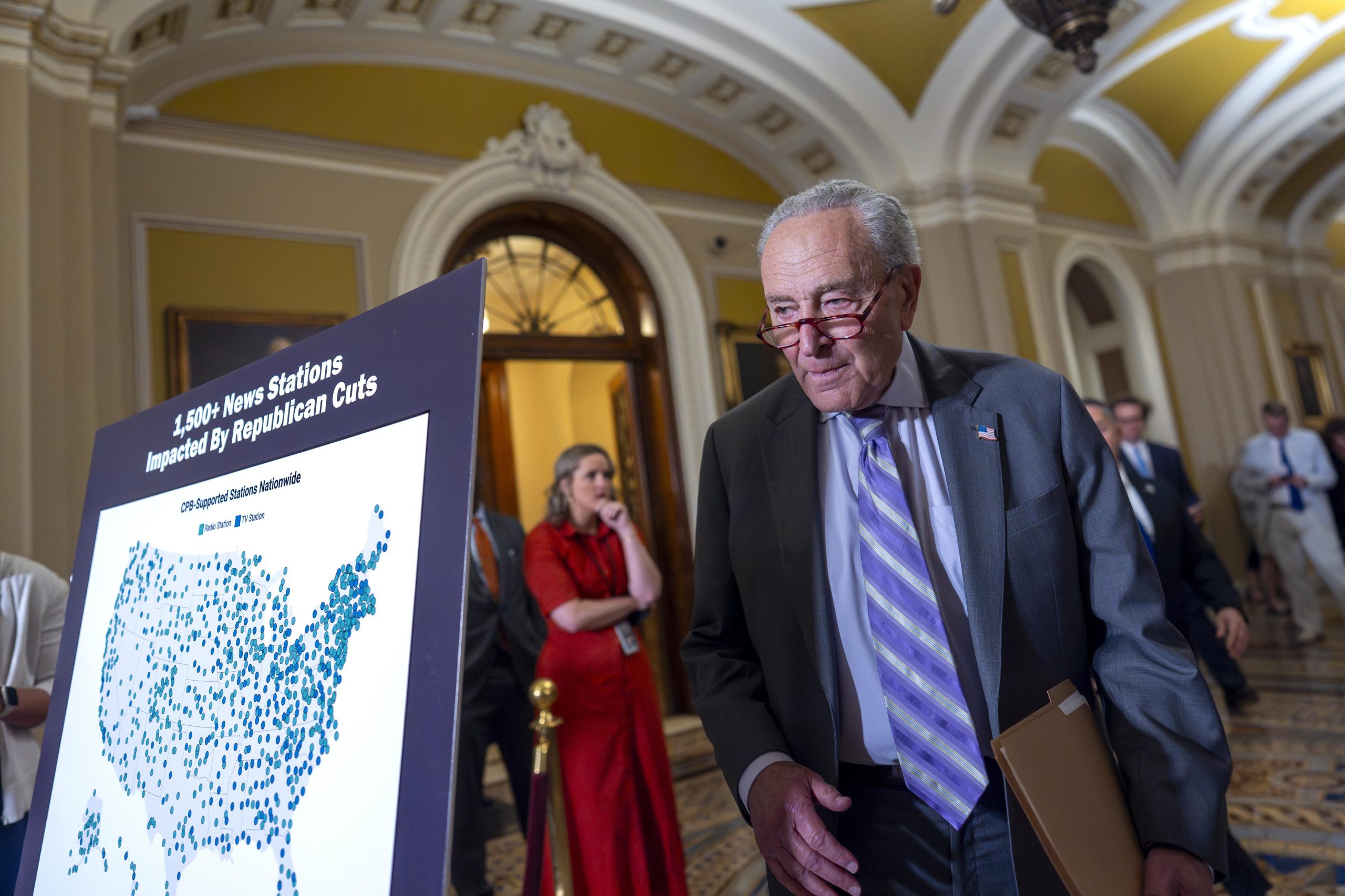
On July 15, Senate Minority Leader Chuck Schumer, D-N.Y., arrives to speak with reporters at the Capitol about Senate Republicans’ efforts to claw back $1.1 billion of funding from the Corporation for Public Broadcasting and about $8.3 billion from foreign aid programs. (J. Scott Applewhite | AP)
The Senate has approved the Trump administration’s $9 billion rescission package aimed at clawing back money already allocated for public radio and television — a major step toward winding down nearly six decades of federal funding for the Corporation for Public Broadcasting.
CPB stands to lose $1.1 billion meant to fund it through the next two years, while the bill also cuts $7.9 billion in other programs. CPB acts as a conduit for federal money to NPR, PBS and their member stations.
In a marathon “vote-a-rama” session that lasted into the small hours of Thursday morning, senators introduced numerous amendments before ultimately voting 51-48 to approve the package that includes cuts to foreign food and health programs. One senator, Minnesota’s Tina Smith, was not present at the vote due to hospitalization.
The Senate’s approval of the cuts tees up a final showdown in the House, which approved an earlier version last month.
The Senate vote was largely along party lines, with Democrats voting against the bill and all but two Republicans voting for it. The GOP exceptions were Maine’s Susan Collins and Alaska’s Lisa Murkowski. Kentucky Republican Sen. Mitch McConnell, who voted on Tuesday not to advance debate on the bill, prompting Vice President Vance to cast a tiebreaking vote, nonetheless approved the final measure.
In a statement immediately after the vote, NPR CEO Katherine Maher said: “Nearly 3-in-4 Americans say they rely on their public radio stations for alerts and news for their public safety,” adding, “We call on the House of Representatives to reject this elimination of public media funding, which directly harms their communities and constituents, and could very well place lives at risk.”
In a separate statement, Kate Riley, president and CEO of America’s Public Television Stations, said the organization was “devastated that the Senate voted to eliminate federal funding to the local public television stations throughout this country that provide essential lifesaving public safety services, proven educational services and community connections to their communities every day for free.”
During the voting, motions by Democrats to carve out funding for NPR, PBS and their member stations from the package were largely symbolic, as Republicans had the numbers.
In one of the late proposed amendments, Murkowski sought to restore CPB funding while barring any federal money from going to NPR. She mentioned a 7.3-magnitude earthquake that struck the Alaska Peninsula and Kodiak Island on Wednesday and an alert she’d received from public radio station KUCB in Unalaska, in the Aleutian islands.
“I’m looking at a text that I received from the station manager there,” she said relating how the station’s three staff members broadcast emergency messages despite a tsunami warning that was later lifted. The text said the local community was instructed to listen to the local public radio station, she said.
“I have an amendment that protects public media, their independence, their ability to provide local news, weather reports and, yes, emergency alerts,” Murkowski said. “We’re reminded today this stuff matters, so I would hope my colleagues would recognize what is at stake and vote for my amendment.”
But a majority voted against it.
Earlier, Wisconsin Democrat Sen. Tammy Baldwin said that if the cuts to public broadcasting stand, “local television and radio stations will shut down — and it will be rural stations that will be the first to close.”
“These issues were not even raised as a part of our appropriation process during the past two years,” Baldwin said. “So to take this extraordinary step and say that these issues are now so grave and so urgent that we have to address them like this — what are we doing here?”
Republican Sen. Ted Cruz of Texas, speaking against the Baldwin motion, said public broadcasting “has long been overtaken by partisan activists. Plain and simple.”
“NPR and PBS have revealed their left-wing bias time and time again,” he said. “If you want to watch the left-wing propaganda, turn on MSNBC. But the taxpayers should not be forced to subsidize it.”
Senate Majority Leader John Thune, R-S.D., noted that the U.S. is $36 trillion in debt. “What we are talking about here is 1/10 of 1% of all federal spending,” he said. “But it’s a step in the right direction.”
The White House sent the request to Congress in early June — the first such rescission in more than a quarter century. The House quickly passed it and is expected to approve the Senate changes before a midnight Friday deadline. That deadline marks 45 days since President Trump sent the rescission request to Congress. By law, Congress is required to either affirm the cuts or do nothing and allow the money to be restored after the deadline.
Since the election, Trump and GOP lawmakers have stepped up attacks on NPR and PBS, with the president writing on his social media platform this week that “[a]ny Republican that votes to allow this monstrosity to continue broadcasting will not have my support or Endorsement.”
In April, Maher, the NPR CEO, and PBS CEO and President Paula Kerger testified on Capitol Hill before the House subcommittee on government efficiency chaired by Georgia Republican Rep. Marjorie Taylor Greene. The executives defended public media against charges of political bias, but Greene concluded the hearing by saying: “We believe that you all can hate us on your own dime.”
NPR, which produces news programs Morning Edition and All Things Considered, gets about 1% of its funding directly from the federal government. Its member stations, which operate over 1,300 outlets, receive about 8% to 10% of their funding from the federal government. With its nightly PBS News Hour and high-quality children’s programming, such as Daniel Tiger’s Neighborhood, PBS and its stations get around 15% of their revenue.
Leaders in the public broadcasting community have warned that losing CPB funding would cripple small stations, especially in rural areas underserved by commercial media, and weaken the entire public media network.
A Harris Poll conducted last week on behalf of NPR found that overall two-thirds (66%) of Americans support federal funding for public radio, with the same proportion agreeing that such funding is a good value for taxpayers. More than half of Republicans (58%) and more than three-quarters of Democrats (77%) said they support public radio funding. The online poll served 2,089 U.S. adults, with a margin of error of +/- 2.5%.
The House version of the bill included eliminating $7.9 billion in foreign aid funding, including for PEPFAR, the U.S. AIDS relief initiative initiated under President George W. Bush. But Collins, who chairs the appropriations committee, along with other Republicans emphasized that cutting life-saving foreign aid programs such as PEPFAR went too far. They decided to exclude the program from the final Senate version.
Murkowski was among a handful of Republicans in rural states who expressed concern about losing funding for public radio stations that cater to under-served populations. Among them, South Dakota Republican Sen. Mike Rounds on Tuesday announced that he had struck a deal for the White House to divert Green New Deal money to funding 28 stations serving Native American listeners in nine states.
But in a letter to Rounds, Native Public Radio President and CEO Loris Taylor called the compromise “structurally impractical,” adding that while the network appreciates the efforts to sustain Tribal media, “The Green New Deal is primarily a framework for climate and economic reform, not a dedicated funding source for communications infrastructure or media services.”
More rescissions requests likely
Ahead of Thursday’s expected House vote, Office of Management and Budget director Russ Vought told reporters that the administration will “likely” send another rescissions package to the Hill soon.
“There is still a great enthusiasm for these rescissions bills, because Congress wants to be a part of voting for these cuts and making them permanent,” Vought said at a breakfast hosted by the Christian Science Monitor.
But Democrats and Republicans alike have raised concerns that rescinding additional funds appropriated by Congress will make it harder for lawmakers to pass future appropriations bills to fund the government ahead of a Sept. 30 deadline.
“The only way we can fund the government is to get at least seven Democrats to vote with us at the end of September 30, or we can go into a shutdown,” Sen. Thom Tillis, R-N.C., said on the Senate floor Wednesday. “If I’m a Democrat, and you’re trying to get me to vote and get to a 60 vote threshold to fund the government, and you’ve just betrayed a prior agreement and a prior appropriation – what are the likelihood that they’re going to do that?”
In a letter to Senate Democrats earlier this month, Senate Minority Leader Chuck Schumer called the rescissions package “an affront to the bipartisan appropriations process.”
“That’s why a number of Senate Republicans know it is absurd for them to expect Democrats to act as business as usual and engage in a bipartisan appropriations process to fund the government, while they concurrently plot to pass a purely partisan rescissions bill to defund those same programs negotiated on a bipartisan basis behind the scenes,” Schumer wrote.
Vought, however, dismissed those concerns at the breakfast, and said he was not willing to provide assurances to Democratic senators.
“There is no voter in the country that went to the polls and said, ‘I’m voting for a bipartisan appropriations process,'” Vought said. “The appropriations process has to be less bipartisan. We’re $37 trillion in debt, and we produce CRs [continuing resolutions] every year, and to the extent that we don’t produce CRs, it’s not individual bills that get signed into law. It’s omnibus bills that no one has read before.”
Disclosure: This story was written and reported by NPR Correspondent Scott Neuman, Congressional Correspondent Deirdre Walsh and NPR Washington Desk Producer Lexie Schapitl. It was edited by Managing Editor Gerry Holmes. Under NPR’s protocol for reporting on itself, no corporate official or news executive reviewed this story before it was posted publicly.
The Senate approved legislation early this morning that will claw back $9 billion in federal funding for NPR and PBS, their member stations and foreign aid programs.
STEVE INSKEEP, HOST:
Senate Majority Leader John Thune, Republican of South Dakota, argued that voters elected Republicans to rein in federal spending.
(SOUNDBITE OF ARCHIVED RECORDING)
JOHN THUNE: It’s a small but important step toward fiscal sanity that we all should be able to agree is long overdue.
INSKEEP: Days earlier, Republicans approved a tax and spending bill that drastically increases federal borrowing, according to the Congressional Budget Office. The recission makes little difference in that overall picture, but does advance some of President Trump’s preferences.
MARTIN: NPR congressional correspondent Deirdre Walsh was up all night watching this. She’s with us now. And I want to mention that no NPR corporate or news executive had a hand in this report. With that being said, good morning, Deirdre.
DEIRDRE WALSH, BYLINE: Good morning, Michel.
MARTIN: So it is rare for Congress to roll back funding for programs its already approved and were signed into law. When is the last time this happened?
WALSH: It is. You know, Thune noted early this morning, it’s been more than 30 years since a recission package passed. The final bill the Senate passed included nearly $8 billion in cuts to foreign assistance programs and $1.1 billion in federal money for public broadcasting. Assuming it passes the House, this is a win for President Trump and his DOGE effort to slash spending. He’s threatened to pull endorsements for any Republicans who voted no. Two did – Lisa Murkowski of Alaska, Susan Collins of Maine, joined all Democrats opposing it. Democrats after the vote called it a dark day and said the bill is going to hurt Americans who rely on public broadcasting and hurt the U.S.’s reputation as a global leader. They also argued Republicans were ceding Congress’ constitutional power of the purse and instead were just taking orders from President Trump.
MARTIN: So Senate Republicans did take out one of the cuts that the administration requested. Would you just remind us which program was spared?
WALSH: Right. They removed a proposed $400 million cut to PEPFAR. That’s a global public health program created by former President George W. Bush to combat HIV and AIDS. Lawmakers from both parties say it’s successful, saved millions of lives. So leaders and the Trump administration did agree to pull that cut out, so the overall package was slimmed down from $9.4 million to $9 million.
MARTIN: So Republicans on Capitol Hill have tried to strip federal funding for public media for decades – some Republicans, I should say, not all.
WALSH: Right.
MARTIN: So say more about their strategy and their thinking around this.
WALSH: Right, this effort to defund NPR and PBS goes back to the 1990s. A lot of Republican lawmakers have criticized what they view as ideologically biased news coverage from public media outlets. NPR executives, I should say, have pushed back at those claims. But once Republicans gain control of Congress and the White House, they had the votes to roll back two years of money Congress already approved just back in March for the Corporation for Public Broadcasting. Senator Murkowski tried to restore this funding, and she cited an emergency alert that she got on her phone just hours before the vote from an Alaska public radio station warning about an earthquake, saying that’s an example of what’s at stake if stations lose federal money. But her effort failed.
MARTIN: So – and what’s been the reaction to this?
WALSH: I mean, NPR’s president has released a statement saying 3 out of 4 Americans rely on public radio stations, say it can’t be replaced and called on the House to reject the bill.
MARTIN: And what’s next?
WALSH: The House is scheduled to vote later today. The clock is ticking. They have a midnight deadline on Friday to get it to the president for his signature.
MARTIN: That is NPR’s Deirdre Walsh. Deirdre, thanks for staying up with us after a very long night. Appreciate it.