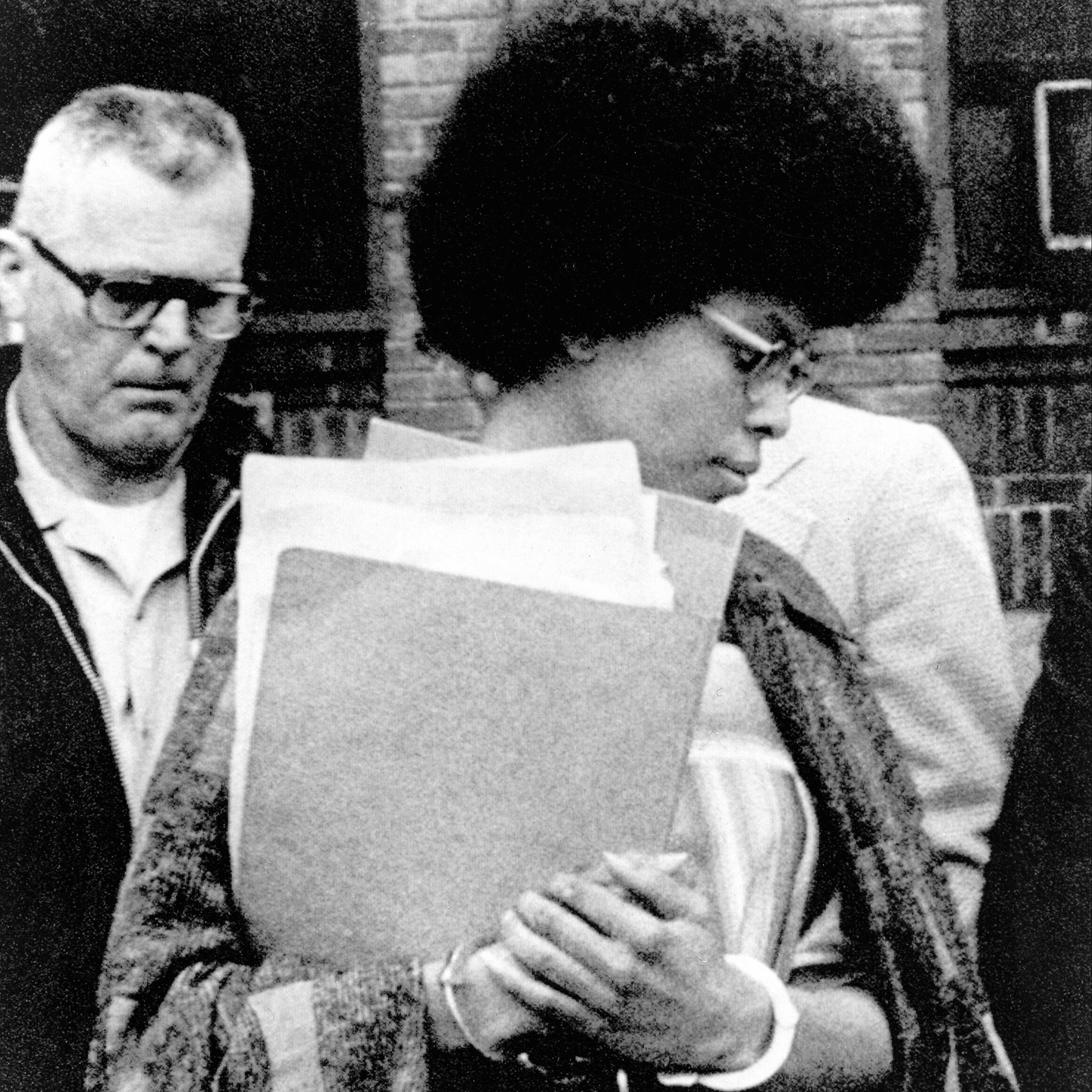
Joanne Chesimard, who used the name Assata Shakur and was a member of the Black Panther Party and Black Liberation Army, leaves Middlesex County courthouse, in New Brunswick, N.J., April 25, 1977. (AP | AP)
Assata Shakur, a Black liberation activist who was given political asylum in Cuba after her 1979 escape from a U.S. prison where she had been serving a life sentence for killing a police officer, has died, her daughter and the Cuban government said.
Shakur, who was born Joanne Deborah Chesimard, died Thursday in the capital city of Havana due to “health conditions and advanced age,” Cuba’s Ministry of Foreign Affairs said in a statement. Shakur’s daughter, Kakuya Shakur, confirmed her mother’s death in a Facebook post.
Officials in New Jersey, where Shakur had been arrested, convicted and imprisoned, said she was 78.
A member of Black Panther Party and Black Liberation Army, Shakur’s case had long been emblematic of the fraught relations between the U.S. and Cuba. American authorities, including President Trump during his first term, demanded her return from the communist nation for decades.
On May 2, 1973, Shakur and two others were pulled over by New Jersey State Police troopers because the car they were driving had a broken taillight.
A gunfight ensued and one of the troopers, Werner Foerster, was killed and another was wounded. One of Shakur’s companions was also killed.
The New York City native fled but was eventually apprehended. She was found guilty of murder, armed robbery and other crimes in 1977 and was sentenced to life in prison. Shakur was charged with additional bank robberies and in the nonfatal shootings of two other police officers, but most of those charges were dismissed or resulted in her acquittal.
Shakur’s prison stint was short-lived, though. In November 1979, members of the Black Liberation Army, posing as visitors, stormed the Clinton Correctional Facility for women, took two guards hostage and commandeered a prison van to break her out.
Shakur disappeared before eventually emerging in 1984 in Cuba, where Fidel Castro granted her asylum.
Offering Shakur safe harbor was one of the most famous examples of Cuba aligning itself with what it describes as revolutionary forces struggling against the oppressive capitalist empire to the north.
Much like Cuba supported anti-colonial and left-wing forces in Africa, Central and South America, the Cuban government saw the armed Black liberation movement in the U.S. as part of a global revolutionary struggle.
New Jersey State Assemblyman Michael Inganamort, who sponsored a resolution last year calling on Cuba to extradite Shakur, lamented Friday that “justice was never served” in Foerster’s death, while the labor union representing New Jersey officers dismissed Shakur “for her crime and cowardice.”
New Jersey Gov. Phil Murphy and State Police Superintendent Patrick Callahan said they would “vigorously oppose” any attempt to repatriate Shakur’s remains to the U.S.
“Sadly, it appears she has passed without being held fully accountable for her heinous crimes,” they said in a joint statement. “Unlike his killer, Trooper Foerster never had a chance to live out his days in peace.”
Sundiata Acoli, who was also convicted in Foerster’s killing, was granted parole in 2022 after being imprisoned for nearly three decades.
In her writings over the years, Shakur has maintained she didn’t shoot anyone and had her hands in the air when she was wounded during the gunfire.
More recently, her writings became a rallying cry during the Black Lives Matter movement, though opponents criticized her words as being influenced by Marxist and communist ideology.
“It is our duty to fight for our freedom. It is our duty to win,” Shakur wrote in Assata: An Autobiography, originally published in 1988. “We must love each other and support each other. We have nothing to lose but our chains.”
Black Lives Matter Grassroots Inc., a collective of racial justice activists from around the U.S., vowed to “fight in her honor and memory.”
Malkia Amala Cyril, an early organizer of the BLM movement, expressed sorrow because Shakur died during a time of rising authoritarianism.
“The world in this era needs the kind of courage and radical love she practiced if we are going to survive it,” said Cyril, whose late mother had been part of the Black Panthers in New York alongside Shakur.
Shakur’s influence extended into the music world. She was famously close to the family of late rapper Tupac Shakur, who had considered her a godmother.
Public Enemy, the political hip-hop group and Rock and Roll Hall of Fame inductees, are thought to be the first major artists to reference Shakur. The 1988 song Rebel Without a Pause, from the album It Takes A Nation, includes the lyrics “supporter of Chesimard,” referring to her legal name.
Rapper Common told Shakur’s story in his 2000 song A Song for Assata. The Grammy award-winner’s invitation to a White House poetry event in 2011, during the Obama administration, drew outrage from conservatives and law enforcement groups who felt it was disrespectful to Foerster’s family and police officers broadly.