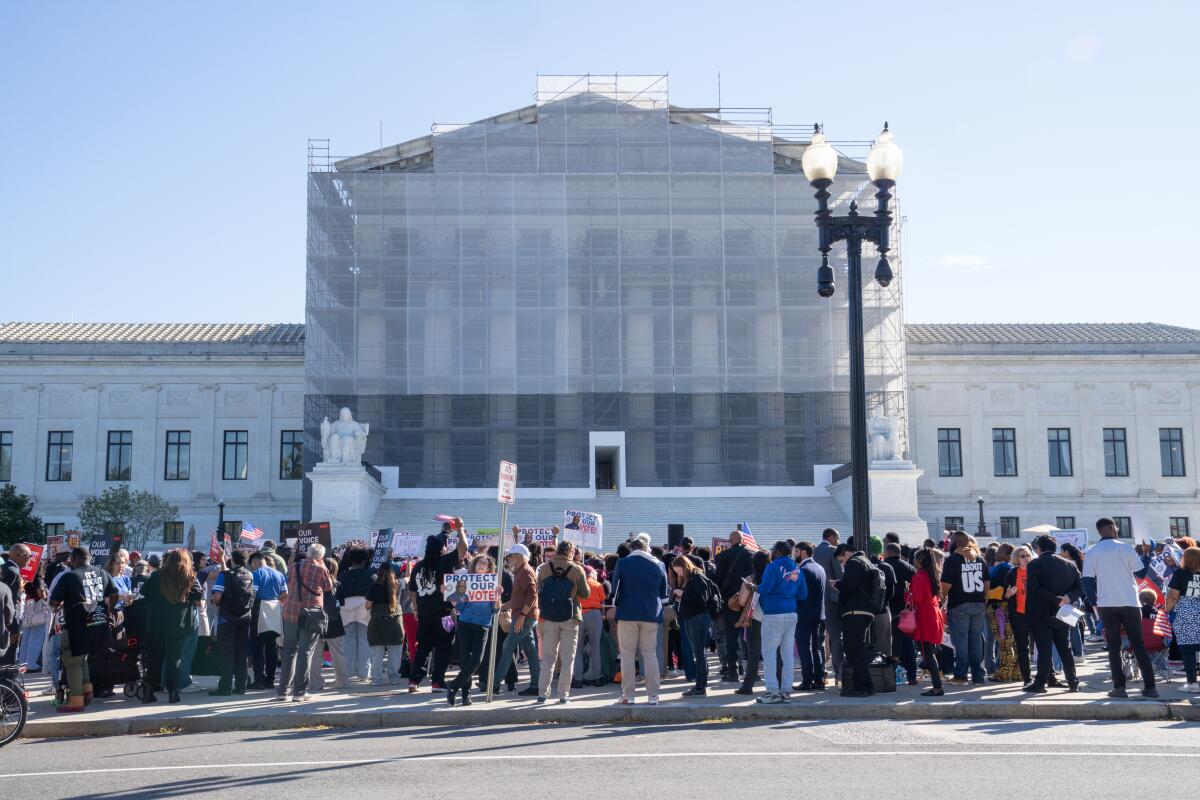
People gather in support of minority voting rights outside the U.S. Supreme Court in Washington, D.C., on Wednesday. (Claire Harbage | NPR)
The Supreme Court on Wednesday seemed headed for another ruling that undercuts the landmark 1965 Voting Rights Act.
Once considered the jewel in the crown of the civil rights movement, the Voting Rights Act has been largely dismembered since 2013 by the increasingly conservative Supreme Court. The major exception was a decision just two years ago that upheld the section of the law aimed at ensuring that minority voters are not shut out of the process of drawing new congressional district lines.
But on Wednesday, Chief Justice John Roberts, who wrote that decision, downplayed the importance of the ruling, suggesting he didn’t see it as controlling the outcome in Wednesday’s case.
At issue in the more than two hours of arguments before the court was the redistricting map drawn by the Louisiana legislature after the decennial census. Following years of litigation, the state, with a 30% Black population, first fought and then finally agreed to draw a second majority-Black district. Two of the state’s six House members are African American.
Normally, that would have been the end of the case, but a self-described group of “non-African-American voters” intervened after the new maps were drawn up to object to the legislature’s redistricting.
Supporting them in the Supreme Court Wednesday, Deputy Solicitor General Hashim Mooppan contended that the Black voters should not have gotten a second majority-minority district.
“If they were all white, we all agree they wouldn’t get a second district,” he said.
The court’s liberal justices pointed out that the federal law is based on the effects of redistricting in a state like Louisiana where, as they noted, voters are so racially polarized that even white Democrats for the most part don’t vote for Black candidates. But the court’s conservatives seemed to have a different view. Justice Samuel Alito, for instance, said that seeking a partisan advantage is not the same thing as seeking a racial advantage.
That’s not so, replied lawyer Janai Nelson, of the NAACP Legal Defense Fund. If race is used to gain partisan advantage, she maintained, that is unconstitutional.
“The extremely racially polarized voting that we have in Louisiana cannot be explained away by party,” she said. “We’re talking about racially polarized voting that is above 84%.” That would essentially mean that all but 16% of white voters do not vote for Black candidates.
Justice Brett Kavanaugh, who cast the decisive fifth vote in a similar case from Alabama two years ago, reiterated his view that there should be an end point to racial remedies like this one.
“This court’s cases in a variety of contexts have said that race-based remedies are permissible for a period of time … but they should not be indefinite,” he said on Wednesday.
But Nelson replied that while many provisions of the voting rights law did have time limits, Congress deliberately refused to put a time limit on this provision. What’s more, she said, the non-discrimination element of the Fifteenth Amendment to the Constitution, which gives Congress the power to enforce the right to vote, also has no time limit.
Justice Elena Kagan asked Nelson what the results would be if the court were to nullify or otherwise limit the redistricting provision of the federal law.
“I think it would be pretty catastrophic,” replied Nelson, noting that the African American House members elected across the deep South had won their seats because of the federal law that forced creation of majority-minority districts.
Justice Neil Gorsuch followed up, asking whether the much vaunted “breathing room” in the statute “intentionally discriminates on the basis of race.”
“No,” replied Nelson, adding that the only breathing room in Louisiana was to ensure that districts drawn to dilute the Black vote are eliminated.
Countering that argument was Louisiana Solicitor General Benjamin Aguinaga. He told the justices that “race-based redistricting is fundamentally contrary to our Constitution.”
At that, Justice Sonia Sotomayor noted that the last time Aguinaga had been before the court in this very case last term he had defended the creation of the new majority-Black district.
“Are you walking that back?” she asked.
Aguinaga did not fully answer the question. But the Supreme Court will.
If the court acts quickly, it could facilitate the elimination of Louisiana’s second majority-Black district prior to next year’s congressional election.
Indeed, election law experts say that for Democrats, a worst case-scenario could mean a loss of as many as 19 congressional seats if, as seems likely, the court rules against the existing understanding of the federal election law.
Today, the Supreme Court seemed headed for another ruling that undercuts the landmark 1965 Voting Rights Act. Now, that law was repeatedly strengthened by Congress. It was upheld by the Supreme Court in the decades after it was enacted. But the current conservative court has been largely hostile to it, as NPR legal affairs correspondent Nina Totenberg reports.
NINA TOTENBERG, BYLINE: Once considered the jewel in the crown of the Civil Rights Movement, the Voting Rights Act has been largely dismembered since 2013 by the increasingly conservative Supreme Court. The major exception was a decision just two years ago that upheld the section of the law aimed at ensuring that minority voters are not shut out of the process of drawing new congressional district lines. But today, Chief Justice John Roberts, who wrote the court’s decision two years ago, downplayed the importance of that ruling, suggesting that he didn’t see his decision as controlling the outcome in today’s case.
At issue was a redistricting map drawn by the Louisiana legislature after the decennial census. After years of litigation, the state, with a 30% Black population, agreed to draw a second majority Black district. Normally, that would have been the end of the case, but a self-described group of non-African American voters intervened at that point to object to the legislature’s redistricting. Supporting them in the Supreme Court today, Trump administration Deputy Solicitor General Hashim Mooppan contended that the Black voters should not have gotten a second majority-minority district.
(SOUNDBITE OF ARCHIVED RECORDING)
HASHIM MOOPPAN: If they were all white, we all agree they wouldn’t get a second district.
TOTENBERG: The court’s liberal justices all pointed out that the federal law is based on the effects of redistricting in a state like Louisiana, where, as they noted, voters are so racially polarized that even white Democrats, for the most part, don’t vote for Black candidates.
But the court’s conservatives seemed to have a different view. Justice Alito, for instance, said that seeking a partisan advantage is not the same thing as seeking a racial advantage. That’s not so, replied lawyer Janai Nelson of the NAACP Legal Defense Fund. If race is used to gain partisan advantage, she maintained, that is unconstitutional.
(SOUNDBITE OF ARCHIVED RECORDING)
JANAI NELSON: The extreme racially polarized voting that we have in the state of Louisiana cannot be explained away by party. We’re talking about racially polarized voting that is above 84%.
TOTENBERG: Meaning, essentially, that all but 16% of white voters do not vote for Black candidates. Justice Kavanaugh, who cast the decisive fifth vote in a similar case from Alabama two years ago, today reiterated his view that there should be an end point to racial remedies like this one.
(SOUNDBITE OF ARCHIVED RECORDING)
BRETT KAVANAUGH: This court’s cases in a variety of contexts have said that race-based remedies are permissible for a period of time, but that they should not be indefinite.
TOTENBERG: But Nelson replied that while many provisions of the Voting Rights law did have time limits, Congress deliberately did not put a limit on this provision of the law. What’s more, she said, the nondiscrimination element of the 15th Amendment to the Constitution, which gave Congress the power to enforce the right to vote, also has no time limit.
Justice Kagan asked Nelson what the results would be if the court were to nullify or otherwise limit the redistricting provision of the federal law. I think it would be pretty catastrophic, said Nelson, noting that the African American House members elected across the South had won their seats because of the federal law that forced creation of majority-minority districts. Justice Gorsuch followed up.
(SOUNDBITE OF ARCHIVED RECORDING)
NEIL GORSUCH: So do they have the breathing room to intentionally discriminate on the basis of race?
TOTENBERG: No, replied Nelson, adding that the only breathing room here is to ensure that districts drawn to dilute the Black vote are eliminated. Countering that argument today was Louisiana Solicitor General Benjamin Aguinaga.
(SOUNDBITE OF ARCHIVED RECORDING)
BENJAMIN AGUINAGA: But the avowed purpose of drawing a majority Black district is to diminish the voting strength of some racial groups and augment the voting strength of others.
TOTENBERG: But Justice Sotomayor noted that the last time Aguinaga had been before the court in this very case last term, he had defended the creation of the new majority Black district. Are you walking that back? – she asked. Aguinaga did not fully answer the question.